Pasar Malam Or Pagi
Malaysian street markets are not a uniform shopping experience - the timing of each and what they sell depends heavily on which neighbourhood hosts it. Even markets with the same name differ from one locality to the next.
Market Types and Timing
In Kuala Lumpur, the city council maintains a roster of regularly scheduled pasar malam and pasaran pagi, with each market named for its neighborhood and defined by the day it runs. In principle, a pasar malam is a night market, while a pasar pagi is a morning market. In practice, there are more distinctions.
Night markets set up on different streets on different evenings of the week, with the exact neighborhood hosting the market on a specific night. For example, the Kuala Lumpur directory lists pasar malam operating in Taman Beringin on Wednesday, and in Taman Dato Senu on Tuesday.
Most pasar malam begin as early as 4:00 pm or 5:00 pm, and run until 10:00 pm or 11:00 pm. The Batu Ferringhi Night Market in Penang is an exception, open from 6 PM to 12 AM on Friday, Saturday and Sunday nights. Morning markets by contrast start early, but close in mid-afternoon, such as the TTDI Weekend Market in Kuala Lumpur, which operates on Saturday and Sunday from 7 AM to 12 PM.
Some markets run as weekend markets instead, afternoon into evening, and those draw more visitors and a wider mix of stalls.
What You Buy There
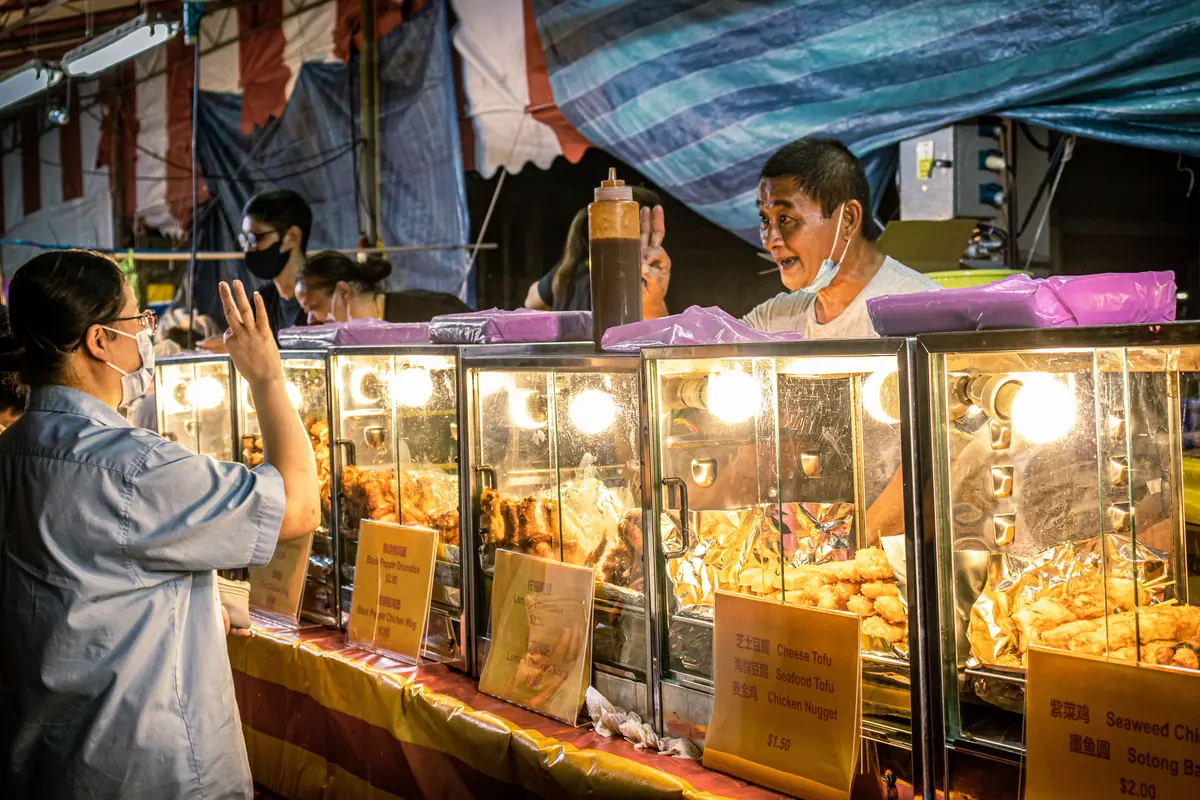
The goods on sale vary by market type, local neighborhood, and market time, with pasaran malam geared towards craving the after-dinner crowd and pasaran pagi focused on daily needs. Food is the single most important element of pasar malam. Street market food in Malaysia is world-famous, and the night markets are the place to try it, with vendors selling a variety of local dishes. The food rows are the crowded ones, so most people eat first and shop after.
A pasar pagi focuses more on household goods and fresh produce, such as fruits and vegetables. Pasar pagi is often a morning lifestyle experience, with food stalls, clothes and tools on offer. Unlike night markets, a pasar pagi tends to offer goods for regular households rather than novelty or tourist souvenirs. Weekend markets blend the two approaches, with food, household goods, and novelty souvenirs all among the goods on offer, though without a single dominant focus like their more frequent siblings.
Paying and Haggling
Malaysian markets, especially street stalls, are still thoroughly oriented around cash, though some larger stores accept credit cards. Smaller shopping areas, including markets, still depend on petty cash, and do not uniformly accept cards, QR payments, or even larger banknotes, so shoppers should carry enough coins and small notes to complete transactions, and expect to haggle.
Vendors often expect you to bargain at a pasar malam, where many items are novelty and tourist souvenirs. Bargaining is normal at an open-air pasar pagi too, even over everyday goods — it is the part of the transaction a supermarket does not have.
Shoppers should see the negotiation as a fun game, an opportunity to grow accustomed to the local flavour, so they would do well to be respectful and not aggressive. The usual opening is to say plainly that you want the thing but do not know the price, and to ask what is fair. Petaling Street and the bigger night markets are where the haggling is most expected, and where a first attempt at it does least damage.